We've been building hardscape out of Medford since 1989 — 37 years. Belmont is about fifteen minutes from our yard, and we've worked all over it, from the flat Winn Brook streets to the ledge and grade up on Belmont Hill.
Belmont has two problems most contractors handle badly: tight setbacks and big old trees. Neither one means you settle for a small, plain patio. It means the layout has to be thought through before the excavator shows up.
Where we work in Belmont
Belmont Hill — larger lots, serious grade, mature oaks and beeches, and a lot of ledge. This is wall-and-terrace country. When a yard drops eight feet from the back door to the property line, you don't get one patio, you get two levels and a set of steps.
Cushing Square — the streets around Common Street and Trapelo Road. Older single-families and two-families on modest lots, driveways tight to the house, back yards that need every square foot working.
Waverley Square — smaller lots closer to the Fitchburg line, more two-families. Access is usually one narrow side yard, which shapes how the job gets built.
Belmont Center and Payson Park — well-kept older homes, deep front yards, mature street trees, and homeowners who care what the front walk looks like from the sidewalk.
Winn Brook — flatter, denser, and where drainage matters most because there's nowhere for water to run off to.
What we build in Belmont
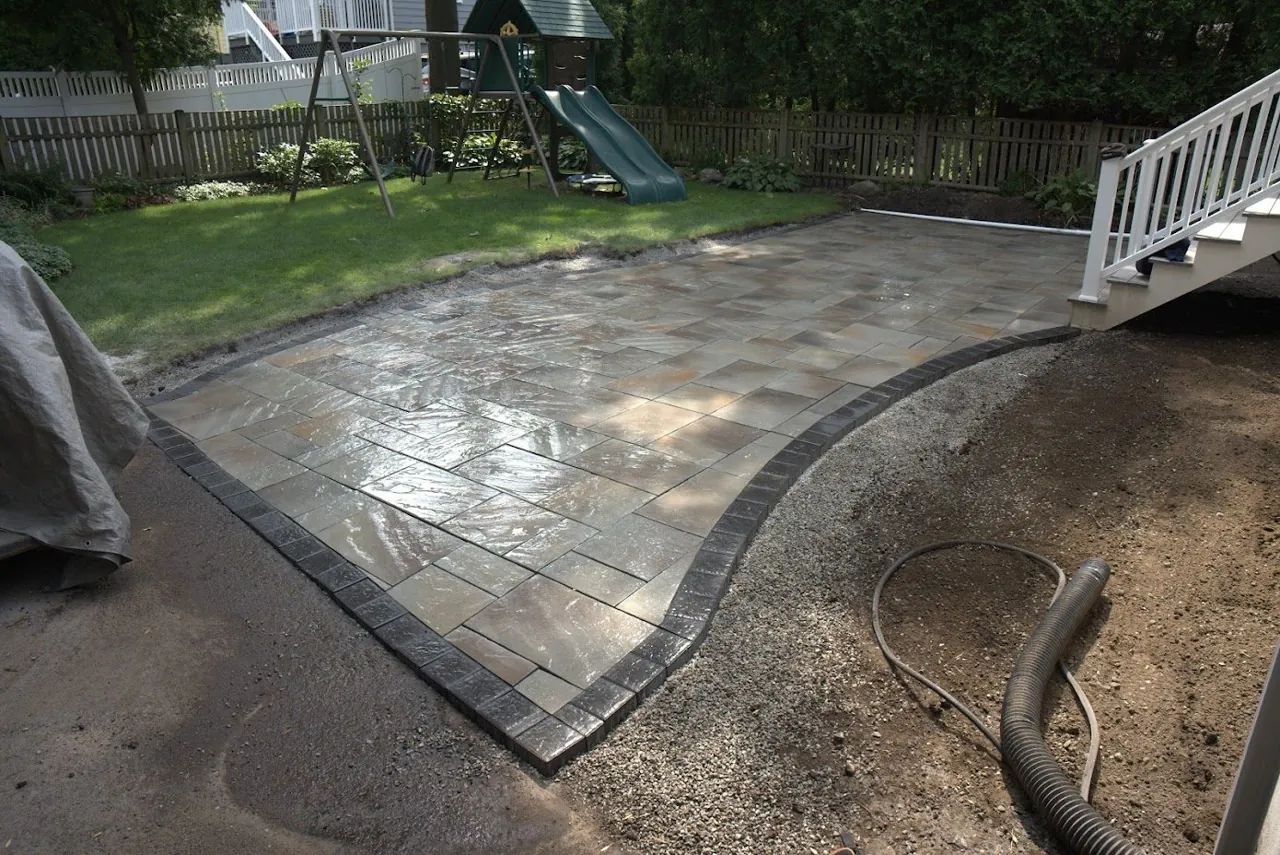
Paver patios and bluestone terraces. On Belmont Hill we're usually building a terrace off a rear door with a wall holding the grade behind it. Down in Cushing and Waverley it's a compact patio sharing the yard with a driveway and a shed.
Retaining and stone walls. Belmont has plenty of old fieldstone walls that have bellied out or dropped. We rebuild them and we build new — segmental block where it's structural, natural stone where the house calls for it. See our masonry and hardscape work.
Walkways, steps and front entries. A lot of Belmont's value is at the curb. Granite or bluestone treads on a proper footing, laid so they don't shift.
Drainage. Flat lots near Winn Brook and Clay Pit Pond hold water. We solve that with pitch, pipe and permeable paving rather than hoping it goes away.
Courtyards and walled gardens. Side yards between a house and a fence make excellent enclosed spaces if you treat them as rooms instead of leftovers — more on courtyard landscaping.
Synthetic turf. Under a mature oak canopy, grass loses. Turf doesn't.
Plus paver driveways, permeable paving, outdoor kitchens, lighting, planting and patio repair.
What it costs
We publish real numbers. Almost nobody else in this business does.
- Paver & brick patios, installed: about $38 per square foot. A 400 sq ft rear terrace runs about $15,200. Natural bluestone runs about $50 per square foot.
- Permeable paver driveway, installed: about $35 per square foot.
- Asphalt driveway removal and haul-off: about $5,300 for a typical 1,800 sq ft drive.
- Synthetic turf, installed: $15–$20 per square foot, with small patches under about 300 sq ft at the top of that range.
- Building permit: $250, passed through at cost.
What moves the price in Belmont specifically: ledge. If we hit rock on the Hill, excavation gets slower and more expensive, and we'll tell you before we start rather than after. Grade, wall height, distance from the street to the work area, and material selection are the other big drivers.
Permits and rules in Belmont
Stormwater. Belmont has a Stormwater Management and Erosion Control bylaw (Chapter 60, Article 3, § 60-325). It triggers at 2,500 square feet of land disturbance, or when impervious surface goes past 25 percent of the lot — but here's the part most people don't know: the bylaw exempts lots with one, two or three dwelling units that existed when the article took effect, unless the lot is over an acre or the work involves substantial demolition. So for a typical Belmont house getting a patio, it usually doesn't apply. We confirm which side of that line your lot falls on before we lay anything out, because "usually" isn't good enough when there's a permit involved.
Retaining walls. Under Massachusetts building code (780 CMR 105.2), retaining walls not over four feet measured from the bottom of the footing to the top of the wall are exempt from a building permit, unless the wall supports a surcharge. Belmont Hill walls frequently exceed that, and frequently support something above them. When that's the case we file the permit and get engineering where it's required.
Demolition delay. Belmont has a demolition delay bylaw (§ 60-320). It's aimed at buildings rather than patios, but if your project includes taking down a structure, factor it in.
Wetlands and conservation. The Belmont Conservation Commission administers the state Wetlands Protection Act locally. If you're near Clay Pit Pond, Beaver Brook or any of the town's brooks and drainage ways, work in the buffer can require a filing. Check your address with the Commission before design is finalized.
Trees. Public shade trees in the town right-of-way are the Tree Warden's, not yours — that includes the strip between the sidewalk and the street. For private trees and any current tree bylaw provisions, check with the town before removal, because rules in this area change.
Curb cuts and street openings. Touching the apron or opening the street means a DPW permit. We handle that filing.
What working with us looks like
Call (781) 859-5304 or request a quote. You hear back within 24 hours. Allan walks the property, measures, checks grade and where water currently goes, and asks what you actually use the yard for.
The quote is written, itemized, and uses real square footage. Permits show as a $250 pass-through.
Access is the Belmont conversation. On Belmont Hill we can often get a machine into the back. In Cushing Square and Waverley we're frequently working through a four-foot side gate with buggies, which affects the schedule — we tell you that up front instead of discovering it on day one. Typical patios run three to seven working days. Walls, steps and multi-level terraces run longer.
Fully insured, 4.6 stars across 57 Google reviews, and Allan is on site.
Common questions
Will a patio push me over Belmont's impervious surface limits?
Usually not. Belmont's stormwater bylaw exempts lots with one, two or three dwelling units, unless the lot is over an acre or the project involves substantial demolition — in which case the 2,500 square foot disturbance and 25 percent impervious thresholds apply. We check which side of that you're on during the quote. And if you're close either way, permeable pavers solve it — water goes through the surface instead of running off.
Can you build on ledge?
Yes. Belmont Hill has plenty of it. Sometimes the answer is a raised terrace with a wall rather than digging down. What we won't do is skip excavation and lay pavers on thin base because rock got in the way — that's exactly the shortcut that produces a sunken patio in three years.
There's a 90-year-old oak in the middle of my yard. Now what?
We design around it. Root zones need protecting, and heavy equipment inside the drip line does damage you don't see for years. A patio can be laid nearby with a modified base, or turf can go under it. Removing a mature tree to build a patio is usually the wrong trade.
How soon can you start?
Depends on the season. Spring and early summer book out. Call early. We'll give you a real date, not a maybe, and if we're booked past what you need we'll tell you rather than string you along.
Thinking about a patio in Belmont?
Call (781) 859-5304 and ask Allan for a free on-site quote. We come to you, measure the yard, and put real numbers on paper.
Get a Free Quote 📞 (781) 859-5304