Synthetic turf installs at $15 to $20 per square foot in the Boston area — small patches under about 300 sq ft price at the high end because the fixed costs spread over fewer feet. A 400 sq ft city yard runs roughly $6,000 to $8,000. It's the right call for shaded triple-decker yards and dog runs. It's the wrong call for a big sunny lawn you actually like.
We've installed hardscape and landscape around Boston since 1989 — thirty-seven years. Turf became a real part of the work because of one specific problem we kept seeing: small city yards where grass simply will not grow, no matter how many times the homeowner reseeds it.
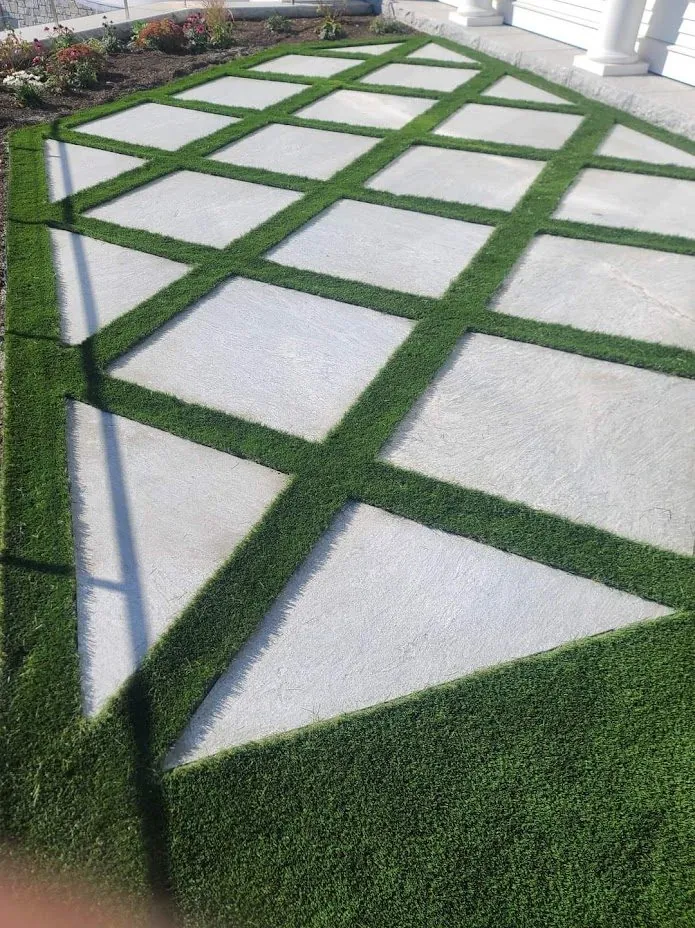
Who should get turf, and who shouldn't
Straight answer, because most of what's written about turf online is written by companies that sell turf.
Turf makes sense if:
- Your yard is shaded by a triple-decker, a fence and two maples, and grass has never taken.
- You have dogs and the lawn is dirt and holes by June.
- Kids use it hard and you want it green in August.
- There's no hose bib, no irrigation, and no realistic path to watering.
Skip turf if:
- You have a large, mostly sunny yard where grass grows fine. Turf is more expensive up front than reseeding and it will never look better than a healthy lawn.
- The area bakes in full afternoon sun and people go barefoot on it. More on that below.
- You want a genuine pollinator or garden space. Turf is a surface, not an ecosystem.
- Budget is the driver. At $15–20 a foot, turf is not the cheap option.
We'll tell you on site if we think you shouldn't do it. We'd rather build you a small paver patio than sell you turf you'll regret.
The install spec we actually use
The base is the whole job. The turf is the last two hours.
- Excavate the subsoil out. Not scalp the grass — dig out the organic topsoil and clay. Organic material decomposes and settles, and settled turf shows every dip.
- 3/8" gravel base, compacted. We bring the base in, grade it to pitch, and compact it in lifts. This is the layer that carries the surface and moves the water.
- Turf laid out and relaxed. Rolled out, allowed to sit so it lies flat, seams cut and joined, grain running the same direction throughout.
- Pinned. Secured around the perimeter and through the field so it can't creep or lift.
- Sand infill brushed in. Power-broomed into the fibers. Infill weighs the turf down, holds the blades upright, and is a big part of how the surface drains and how it handles pets.
Anybody can roll out turf. What separates a five-year job from a fifteen-year job is whether the subsoil came out and whether the gravel got compacted properly. Built right, it stays flat.
We go deeper on the sequence here: synthetic turf installation guide for Boston.
Drainage over urban clay
A lot of soil around Somerville, Cambridge and Dorchester is heavy clay and old fill. Water doesn't move through it quickly. Turf backing is perforated, so water goes straight through the turf — the question is what happens once it hits the ground.
That's why the compacted gravel layer matters. It gives water somewhere to spread out and it gives us a surface we can pitch. On yards where the clay is bad or the yard sits low, we'll add a perforated drain line in the base tied to a suitable outlet before the turf goes down. Cheap to do during install. Expensive to add later.
If your yard already ponds, read why yards and patios pool water before you decide on a surface.
Turf and dogs
This is why half our turf calls come in.
What causes the smell. It isn't the turf. Urine passes through the backing, but the solids and ammonia residue left in the infill and at the base of the fibers feed bacteria, and bacteria is what you smell — especially on a warm, still day.
What handles it:
- Infill choice. Standard silica sand works, but an antimicrobial-coated or zeolite-type infill is designed to trap and hold ammonia rather than let it sit and off-gas. Worth the upgrade if a dog uses the yard daily. Ask us for the specific product on your quote.
- Rinsing. A hose-down once a week in warm weather does most of the work. Water flushes the residue through the base instead of leaving it in the fibers.
- Picking up solids promptly. Same as a lawn.
- Drainage. If the base doesn't drain, nothing else you do will fix the odor. Back to the base.
Dogs also can't dig it up, wear it to dirt, or track mud into the house. For a small city yard with a dog, turf solves a problem grass never will.
Shaded triple-decker yards
Half the back yards in Somerville and Dorchester get two hours of direct sun. Grass seed goes down every April and by July it's moss and bare soil.
Turf doesn't care about light. It looks the same in a shaded side yard between two three-deckers as it does in an open yard. That's the single strongest case for turf in this market, and it's also where turf runs coolest — shade keeps the surface temperature down.
Shaded yards are usually small yards, which is where we spend most of our time. See courtyard landscaping in Boston for what we do with the tight ones.
Heat in full sun — the honest part
Turf gets hot. Published research on synthetic sports surfaces has recorded surface temperatures well above natural grass — Penn State's Sports Surface Research Center has documented synthetic turf running dramatically hotter than natural grass on hot days, with peak readings on sports fields far above ambient air temperature.
Back yards aren't stadium fields, and residential landscape turf with sand infill isn't the same product as crumb-rubber sports turf. But the principle holds: plastic fibers in full sun get hotter than living grass, which cools itself by transpiring.
What that means practically:
- In shade, it's a non-issue.
- In full afternoon sun in July, expect it to be noticeably warm underfoot. Hosing it down cools it quickly but temporarily.
- If you plan to sit or lie on it barefoot in full sun, think hard, or plan shade — a tree, a sail, a pergola.
We're not going to tell you turf stays cool. It doesn't.
Turf vs. a small paver patio vs. keeping the lawn
| Option | Installed cost | Best when |
|---|---|---|
| Synthetic turf | ~$15–20 / sq ft | Shade, dogs, small yards, no irrigation, you want green year-round |
| Paver patio | ~$38 / sq ft | You want usable outdoor living space — table, chairs, grill; a 12' × 12' patio is about $5,500 |
| Bluestone patio | ~$50 / sq ft | You want natural stone; a 12' × 12' bluestone patio is about $7,200 |
| Reseed / sod the lawn | Lowest up front | Decent sun, no dogs, you don't mind watering and mowing |
A lot of our best small-yard projects are a combination: a paver patio where the table goes, turf on the rest. Compare the tradeoffs in synthetic turf vs. a natural lawn, and see paver patio cost in Boston for the patio side of that math.
Real cost numbers
| Area | Rate | Installed cost |
|---|---|---|
| Small patch or dog run, 200 sq ft | ~$20 / sq ft | ≈ $4,000 |
| Typical city back yard, 400 sq ft | ~$15–20 / sq ft | ≈ $6,000 – $8,000 |
| Larger yard, 800 sq ft | ~$15–17 / sq ft | ≈ $12,000 – $13,600 |
| Paver patio or walkway (for comparison) | ~$38 / sq ft | 200 sq ft ≈ $7,600 |
| Building permit, if required | $250 | Pass-through, no markup |
Anything under roughly 300 square feet prices at the high end of the range. That's not a surcharge — it's that excavation, hauling, base delivery, the compactor and the crew cost about the same whether we're covering 200 feet or 800, so on a small job those fixed costs spread over fewer square feet.
Drain lines, removal of an existing surface, edging and border work are quoted separately. Final number comes from the on-site measure. More on how we price and how payment works on our cost and payment page.
Lifespan and what fails first
Manufacturers commonly warranty residential turf in the 8 to 15 year range, and well-installed turf frequently outlives that. Two things fail first, in this order:
- Infill compaction and matting. The fibers lie down and the surface stops looking like grass. This is maintenance, not failure — power-brooming and topping up infill brings it back. Plan on it every couple of years in high-traffic areas.
- Seams and edges. If seams were glued sloppily or the perimeter wasn't pinned into a solid edge, they lift. This is an install defect, not a product defect.
What almost never fails is the fiber itself, and what always fails is a bad base. Turf laid over uncompacted soil telegraphs every low spot within two seasons and there is no fixing it without pulling the turf up.
Where we work
Somerville, Cambridge, Medford, Boston proper — Charlestown, North End, South End, South Boston, Back Bay, Beacon Hill, Dorchester, Jamaica Plain — plus Brookline, Malden, Everett, Arlington, Belmont, Watertown and Winchester.
Turf is usually one piece of a bigger plan. See landscape design in Boston, patio design in Boston, patio design in Medford, and patio design in Belmont.
Get a free on-site quote
Call (781) 859-5304. Tell us roughly how big the yard is and whether there's a dog. We come out, measure, look at how the yard drains, and give you a written price back within 24 hours — free, and no pressure to sign anything.
If we think turf is the wrong answer for your yard, we'll say so.
American Elm Landscape / Boston Patio Design, 150 Rivers Edge Dr, Medford, MA 02155. Fully insured. Building since 1989. 4.6 stars across 57 Google reviews.
Questions before you're ready for a quote? Ask Allan.
Frequently asked questions
How much does artificial grass cost in Massachusetts?
We install synthetic turf at $15 to $20 per square foot. A 400 square foot city back yard runs about $6,000 to $8,000, and a small 200 square foot dog run about $4,000. Patches under roughly 300 square feet price at the high end because the fixed costs of excavation, hauling and base work spread over fewer square feet.
Does artificial grass smell if you have dogs?
It can, but the turf isn't what smells. Urine passes through the backing; the residue left in the infill feeds bacteria, and that's the odor. An antimicrobial or zeolite-type infill plus a weekly hose-down in warm weather handles it. If the base doesn't drain, nothing else will fix it.
Will synthetic turf work in a shaded Boston back yard?
Yes, and that's the best case for it. Turf doesn't need light, so a shaded side yard between triple-deckers looks the same as an open one. Shade also keeps the surface cooler. If grass has failed in your yard for years, this is why.
Does artificial turf get too hot?
In full sun it gets noticeably warm — research on synthetic sports surfaces has recorded surface temperatures far above natural grass on hot days. Residential turf with sand infill isn't identical to sports turf, but the principle holds. In shade it's a non-issue. In full afternoon sun, plan shade or expect to hose it down before barefoot use.
How long does synthetic turf last?
Residential turf is commonly warrantied in the 8 to 15 year range and often lasts longer when the base is right. What goes first is infill compaction and matting, which is fixed by power-brooming and topping up infill. Seams lifting is an install defect, not wear. A poor base is the one failure you can't repair.
What goes under the turf?
We excavate the subsoil out, bring in 3/8 inch gravel and compact it to grade, lay the turf, pin it down, and brush sand infill into the fibers. The compacted gravel is what makes it drain and what keeps it flat. Turf laid straight over the existing soil will settle and show dips within a couple of seasons.
Thinking about turf?
Tell us how big the yard is and whether there's a dog. We'll come measure, look at the drainage, and put a real number in writing — free, no pressure.
Get a Free Quote 📞 (781) 859-5304